The magic of Si point Hegu (Li-4)

Hegu is one of the points included in the merger of the large intestine which starts from the tip of the index finger to between the meeting of the metacarpal bone 1 and 2, upward into the curve of the extensor M tendon in the position of longus and brevis, walking along the radial side of the lower arm until On the Lateral Angle of the Elbow Fold, Again Runs the Lateral Edge of the Upper Arm Towards the Shoulder Then Walks Back to Meet the Meridia-Meridian at the Point Ta Cui (Gv 14) Returns Again to the Supraclaficular Area Penetrates Into the Lung and Penetrates the Diaphragm Arrives In the large intestine.Hegu is a very commonly used point, because it has many benefits and is one of the points in 12 Heavelny star points because it has many benefits. This hegu point is useful for every condition related to the face and head. This is also useful for hot wind conditions (flu). Hegu LI 4 is known as a point of pain in the body. Wherever there is pain, use LI 4. Hegu has the characteristics: removing external heat, expelling the wind, cleaning the lung chi, launching the large intestine and stomach chi. It is recommended that Hegu points for needling not be used for pregnant women if in the BU method (tonification) while in the Shi method (sedation) May and may be allowed.Practical use techniques at Hegu points can be done by pinching with nails, massaging, pinching, rubbing. If you use an acupuncture needle you can stick it perpendicular as deep as 0.5 - 0.8 cun. Cun is around 33 mm so it's around 1.6 cm more.Location This point is located between 1 and 2 metacarpal bones. This can be found by following three methods:


 Open and stretch the thumb and index finger, then place the transverse fold from the thumb of one hand at the midpoint of the extended margin between the thumb and index finger of the other. The place where the tip of the thumb extends is Hegu (Large Intestine LI4).2. 2.A perpendicular fold will appear if the thumb and finger index are tightened, along with existing muscular processes. The point is above the level of the muscle with the tip of the fold perpendicular.3. With the thumb of the index finger apart, the point will be halfway along the line connecting the combined 1 and 2 metacarpal bones and the midpoint of the margin between the thumb and index finger.Indications for Hegu Acupuncture Points

    
front and side headaches,
    
sore throat,
    
swollen red eyes,
    
nosebleed,
    
tooth ache,
    
facial swelling,
    
paralyzed,
    
baby diarrhea,
    
accomplice convulsions,10. heat pain doesn't sweat,11. Menstruation doesn't come,12. difficulty giving birth,13. Difficult defecation.The various functions of Hegu point (Li-4) are as follows:


LI-4 also has a strong and direct effect on the face, so that in the event of an invasion of the causes of external diseases, it is used to remove nasal obstruction, sneezing, burning eyes and so on.
    
LI-4 regulates perspiration and defense qi that are present between the skin and muscles, so that it can be used to stop and increase sweating due to the invasion of factors that cause outbreaks of wind. To increase perspiration, LI-4ditonification and KI-7 Fuliate (sedation). The reverse is true for stopping sweat expenditure, LI-4disedasi and KI-7ditonification.
    
LI-4 also stimulates the spread of pulmonary qi, which explains its strong action (role) in removing the causes of external diseases and wind, so that it is used for symptoms (symptoms) and signs such as nasal congestion, sneezing, coughing, neck stiff, hate (hate) cold and floating pulse (i.e. the initial stage of common cold, influenza, or diseases due to other causes of external diseases). Because this point stimulates the spread of lung qi, making it useful for relieving symptoms of allergic rhinitis.
     
LI-4 has a very strong and antispasmodic action (role), so it is used in many painful conditions, both on meridians and organisms, especially in the stomach, intestine and uterus.
    
LI-4 is widely used as a distal point in pain or shoulder pain syndrome, because it removes interference from the meridians. Because Hegu has a strong direct influence on the face and eyes, ears, nose and mouth, it is often used as a distal point when treating facial problems, including the mouth, nose, ears and eyes, for example allergic rhinitis, conjunctivitis, mouth ulcers ( mouth ulcers), styes, sinusitis, nosebleeds, toothache, trigeminal neuralgia, facial paralysis, frontal headaches.
     
LI-4 is a distal point that is important for facial problems such as eye and mouth deviations that follow wind attacks, peripheral facial paralysis and trigeminal neuralgia.
    
LI-4 is sometimes combined with Taichong's LR-3 (this combination is called the 'Four Gates'), to remove the Wind inside or outside of the head, stop the pain and calm the mind.
    
LI-4 has a strong influence on the mind and can be used to calm the mind and eliminate anxiety, especially if combined with the Taichong LR-3 and with the Du-24 Shenting and GB-13 Benshen. Although rarely used in this way LI-4 is used more as a tonification point than its general use as a sedation point. Combined with other points, it can strengthen Qi and consolidate the Outer Pathogen Factor (ie strengthen Defense Qi). In order to do this, LI-4 is combined with ST-36 Zusanli and Qihai Ren-6. This treatment can be used for chronic allergic rhinitis due to Lung Qi deficiency and the weakness of the outer energy layer (ie Defense Qi), which makes a person susceptible to chronic wind attacks. This treatment is only suitable between attacks to strengthen the Qi and the External Pathogen Factor to strengthen the Defense Qi to repel the Wind
    
LI-4 can balance the ascending Yang and decreasing Yin. This means that LI-4 can be used to weaken opposition to rising Qi (such as rising stomach Qi, lung Qi, liver Qi) or to lift Qi when Qi sinks (such as the sinking of the spleen Qi). So, in the former case, it can be used to weaken Gastric Qi in epigastric pain, elevate / rise of the liver in migraines (especially combined with LR-3 Taichong) or Lung Qi in asthma. In the latter case, it is used to remove the Spleen Qi, especially in combination with Qihai Ren-6. However, this last use is not common. Finally LI-4 is an empirical point for increasing birth during labor, therefore Li-4 is a contraindication in pregnancy.


Old Forgotten Health Tips8520/

1. meridian therapyMeridian is a body tissue that controls the flow of blood power and life throughout the body to ensure the functioning of all parts. According to Huangdi Neijing (Yellow Emperor), they are the key to good life and health.The ancient people believed that to maintain the smooth flow of the meridians, stimulate, provide massage or do acupuncture to the Hegu, Neiguan and Zusanli acupuncture points were the most important, because they were connected to the head, heart and their respective organs.2. MacrobioticsAncient people believe that food and drinks can nourish the body, repair organ damage, prevent disease and help maintain longevity. They advocated the idea "Crops are the main food source, fruit for additives, domestic animals and poultry to add nutrients, and vegetables for supplements." They also see the importance of concocted herbs to bring balance.3. Live according to the seasonAncient wisdom was taken seriously. As the seasons change, so do all living things. So, ancient people believed that humans must eat and live according to the changing seasons. Fighting nature means fighting health.


Titik meridian Lao gong

sumber: https://www.acatcm.com/pericardium-meridian-hand-jue-yin-points/pc-8-lao-gong


PC1-9PC8-9
Nama cina :
Lao Gong 劳 宫
Terjemahan bahasa Inggris :
Istana Buruh
Lokasi :
Di telapak tangan, antara 2 dan 3 metacarpals, proksimal ke sendi metacarpophlangeal.
Ada buku-buku tempat Laogong antara metacarpal ke-3 dan ke-4 (yaitu: di sisi ulnar dari metacarpal ke-3, bukan dari sisi radial).
Klasifikasi :
Titik Ying-Spring dari Pericardium Meridian
Indikasi :
  • Nyeri jantung, epilepsi.
  • Bisul mulut.
  • Bau mulut, psikosis, muntah, ruam kulit, jari mati rasa, ikterus, disfagia, sinkop, epistaksis, diabetes.
  • Getaran tangan, kram penulis, angin dengan sindrom bi di tangan dan erangan, keringat berlebihan pada telapak tangan, radang selaput dada, kepenuhan dan rasa sakit di sisi dada, rasa sakit di sisi mencegah berbalik, kejang diafragma, sensasi Qi naik, hipertensi, ateriosklerosis, kanker lambung, bronkitis, hematuria, darah dalam tinja, wasir, abses panas atau dingin, sakit kepala, migrain, demam tanpa keringat setelah dingin telah terperangkap selama beberapa hari, membuang-buang penyakit pada bayi dengan gizi buruk dan parasitosis .
Fungsi :
Clears Heart Heat, menenangkan Shen.
Catatan :
PC 8 adalah titik terbaik untuk menghapus Heart-Fire. Poin Ying-Spring adalah tempat qi menggiring turun meridian. Titik Ying-Spring diindikasikan untuk panas dalam tubuh dan perubahan dalam kulit. Titik-titik Ying-Spring diketahui membersihkan panas dari meridian.
Tusuk jarum :
Penyisipan tegak lurus .3 - .5 cun


titik meridian Yin tang

sumber:  disini


Dalam praktik pengobatan akupunktur dan akupresur Tiongkok , Yin Tang adalah titik yang terletak di antara tepi bagian dalam alis, yang juga dikenal sebagai area "mata ketiga" pada dahi. Ini dapat diaktifkan melalui akupunktur, akupresur, atau hanya dengan mengistirahatkan perhatian seseorang dengan lembut di area ini.

Lokasi

Meskipun titik akupunktur Yin Tang terletak di sepanjang jalur  Du Mai  (Governing Vessel), itu tidak secara resmi milik  meridian itu . Sebaliknya, itu termasuk kategori poin yang dikenal sebagai "titik luar biasa," yaitu titik yang berdiri sendiri, dalam arti tidak menjadi bagian dari meridian tertentu.
Yin Tang terletak di tengah-tengah di antara ujung medial kedua alis. Dengan kata lain, itu di tengah dahi, di antara alis, pada titik yang sering dikaitkan dengan "mata ketiga." Terjemahan bahasa Inggris dari Yin Tang adalah “Hall of Impression” - menunjuk, mungkin, ke “kesan” intuitif atau visi batin yang dapat diakses seseorang melalui titik ini.

Dantian Atas

Lokasi Yin Tang juga bersesuaian dengan dantian atas, yang secara tradisional diyakini sebagai rumah Shen - salah satu dari Tiga Harta Karun . "Ruang" dantian atas (dikenal juga sebagai "istana kristal") berada di tengah tengkorak, di antara dua belahan otak, tempat kelenjar talamus dan hipotalamus beristirahat. Meskipun titik akupunktur Yin Tang itu sendiri ada di permukaan tengkorak, itu digunakan sebagai portal ke wilayah yang lebih besar dari dantian atas (seperti dalam praktik Senyum Dalam ) - dan karenanya sangat penting untuk latihan qigong dan neidan.

Tindakan & Indikasi

Sebagai titik akupunktur atau akupresur (pijatan sendiri), Yin Tang memiliki kekuatan untuk:
  • Menghilangkan angin
  • Tenang dan hilangkan kecemasan, agitasi atau insomnia 
  • Menguntungkan hidung, membuka hidung tersumbat, rinitis, dan nyeri
  • Mengurangi rasa sakit dan sakit kepala


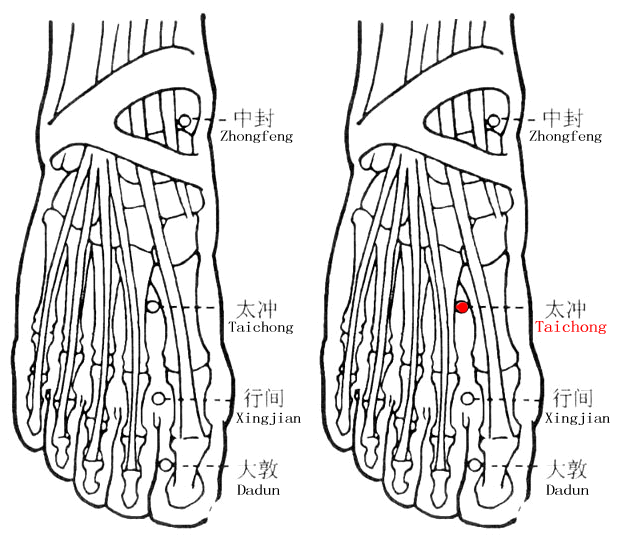
Titik meridian Tai chong

Taichong


Taichong (LR3, 太冲) adalah titik akupunktur di meridian bernama Jueyin Liver Meridian of Foot . Taichong adalah Shu-Stream dan Yuan-Source Point dari hati. Ini adalah titik utama untuk menenangkan hati.

Berarti

Tai, besar; chong, umpan penting.
Intinya adalah di kaki, di mana Qi dari meridian berlimpah. Ini merupakan bagian penting dari meridian ini.

Lokasi

Pada dorsum kaki, pada depresi distal ke persimpangan tulang metatarsal ke-1 dan ke-2.

Indikasi

  1. Hepatitis, cholecystisis, cholelithiosis, ascariasis pada kantong empedu.
  2. menurunkan tekanan darah tinggi, pingsan dan sakit kepala yang disebabkan oleh tekanan darah tinggi, kejang epilepsi.
  3. spermatorrhea, enuresis, amenore.
  4. sakit kepala yang disebabkan oleh api hati, kemerahan dan rasa sakit pada mata.

metode

Penyisipan tegak lurus 0,5-0,8 cun.

sumber: https://tcmwiki.com/wiki/taichong


Titik meridian He gu

Li1-Li5Li1-Li5
Nama cina :
Hegu 合谷
Terjemahan bahasa Inggris :
Bergabung dengan Valley
Lokasi :
Di atas dus tangan, di antara tulang metakarpal ke-1 dan ke-2, dan di sisi radial titik tengah tulang metakarpal ke-2.
Klasifikasi :
Titik Yuan-Sumber Meridian Usus Besar, berguna untuk segala kondisi yang berhubungan dengan wajah dan kepala.
Indikasi :
Nyeri perut • Amenore • Nyeri lengan, • Konstipasi • Ketulian • Deviasi mata • Gangguan mata • Edema wajah • Kelumpuhan otot wajah • Demam Tanpa Berkeringat • Kontraksi jari • Sakit kepala • Hemiplegia • Gangguan usus • Sulit Tenaga Kerja • Deviasi mulut • Mimisan • Parotitis • Gangguan Pernafasan • Gangguan Kulit • Demam Tinggi yang berhubungan dengan dingin • Nyeri Tenggorokan • Sakit gigi 
Fungsi :
Mengusir Angin dan melepaskan eksterior, mengencangkan qi dan memperkuat kekebalan, menghentikan rasa sakit, mengatur area wajah dan kepala, menginduksi persalinan.
  • sangat berguna untuk kondisi Angin-Panas (flu). 
  • dikenal sebagai titik nyeri di tubuh.
  • memiliki fungsi merangsang kontraksi yang efisien.
  • Ini dapat berguna selama persalinan jika kontraksi intensitasnya tidak teratur.
Tusuk jarum :
Tusukan secara tegak lurus 0,5-1 inci. Moksibusi berlaku. Akupunktur dan moksibusi merupakan kontraindikasi pada wanita hamil.
Catatan khusus
BL-60 lebih banyak untuk punggung dan tubuh bagian bawah; LI-4 lebih untuk tubuh bagian atas dan wajah; titik nyeri lainnya adalah BL-60 dan LR-3; LR-3 dan LI-4 adalah "empat gerbang" dan untuk seluruh tubuh sakit dan menggerakkan qi di seluruh tubuh


sumber: https://www.acatcm.com/large-intestine-meridian-hand-yang-brightness-points/li-4-he-gu


Titik meridian Shou san li

Shou San Li (LI10) biasanya digunakan untuk mengencangkan leher, sakit bahu, diare, dan tennis elbow.
Shou San Li (LI10) biasanya digunakan untuk mengencangkan leher, sakit bahu, diare, dan tennis elbow. Shou San Li (LI10) terletak di permukaan luar lengan bawah dan tiga jari lebarnya di bawah lipatan siku ketika siku ditekuk 90 derajat. Untuk menggunakan akupresur pada titik ini, (1) cari titik kemudian (2) gunakan tekanan yang dalam dan kuat untuk memijat dan merangsang area selama 4-5 detik.

Titik tersebut terletak di dekat permukaan lateral siku.

Ruang tiga jari distal ke lipatan siku, dalam depresi di antara otot-otot.

Berikan tekanan dan pijatan selama 4-5 detik.
Saat menerapkan akupresur, cobalah untuk rileks dan bernapas dalam-dalam saat Anda memijat daerah tersebut. Pijat dan akupresur dapat dilakukan sendiri, atau oleh orang lain yang ada di sana untuk membantu Anda.
Beberapa makalah ilmiah menyebutkan bahwa Shou San Li (LI10) bersama dengan Zu San Li (ST36) meningkatkan keteraturan aktivitas myoelectrical lambung [1] yang dapat menunjukkan keterkaitannya dalam mempengaruhi fungsi gastrointestinal.


Nei guan

Titiik Nei guan  Letak 4 jari di bawah bagian dalam pergelangan tanganmu,, titik akupresur untuk mengatasi rasa mual saat hamil, mual karena mabuk, dan sakit kepala. Pijat titik ini perlahan selama 4-5 detik.


Situs Bisnis:

Jasa SEO Semarang

Jasa Pembuatan Website Semarang

Kerajinan Tembaga

Service AC Semarang

Zu san Li

Titik Zu san Li ini terletak di sisi yang menghadap ke luar kaki, sekitar 4 jari lebarnya dari bagian bawah tempurung lututmu
pijat otot pada area titik ini sekitar 4-5 detik, ketika kamu mengalami rasa lelah dan stres berlebih, atau memiliki masalah pada pencernaan.


kunjungi: jasa website semarang
               
                 kerajinan tembaga

           jasa seo semarang

Zhong zhu

Zhong zhu ini terletak di belakang buku-buku jarimu, antara jari manis dan kelingking.
pijat kuat titik ini sambil memijat selama 4-5 detik. Akupresur ini untuk mengurangi sakit kepala yang muncul tiba-tiba, nyeri bahu, otot leher yang tegang, dan nyeri pada punggung bagian atas.

San yin jiao

San yin jiao 4 jari di atas titik tertinggi pergelangan kakimu. Berikan tekanan kuat pada titik ini dan pijat selama 4-5 detik,,
berguna bagi perempuan yang sedang mengalami kram perut karena menstruasi, sakit pinggang, hingga insomnia. Tapi ingat, ibu hamil enggak disarankan melakukan akupresur pada titik ini.

Jian jing

Titik Jian jing terletak di ujung kedua bahu. Kamu bisa memijatnya dengan memberi pijatan ke arah bawah pada kedua titik tersebut menggunakan jari telunjuk atau ibu jari. Pijat titik ini selama 4-5 detik untuk meredakan otot leher yang kaku, tegang pada bahu, dan sakit kepala kronis sehari-hari.

Feng chi

Feng chi letak, genggam tangan dengan saling mengaitkan jari. Kemudian gunakan ibu jari untuk menekan ke titik tengkorak kepalamu. Pijat dan stimulasi area ini selama 4-5 detik. TitikFeng chi ini direkomendasikan saat kamu merasa sakit kepala, migrain, kelelahan, atau mengalami gejala flu.

MERIDIAN USUS BESAR

Large Intestine Meridian (LI)

Uterus interference or disease in the meridian colon (Large Intestine, LI) are: a. Disturbance to the meridian; body temperature rises, thirst, throat pain, epistakisi (bleeding from the nose 0, dental pain and swollen gums, red eyes and pain, neck of the front (enlarged thyroid), sciatica and upper hand, sometimes accompanied inflammation (inflammation) and fever, the index finger can not be moved freely.

b. Gabgguan or abnormalities in the internal organs around the umbilicus (navel) are painful, or abdominal pain with a switched location, borborigmus (stomach rumbling, gas in the intestine), diarrhea or impurities are not formed, may be accompanied by mucus, breath.

Meridian Journey: Starting From The Finger Edge Among The Metacarpal Bone I And II, Up Into The Curve Of Tendon Mm. Extensor Polis Longus And Brevis, Walking Continually Side Radial Arm Down To The Lateral Folding Angle Elbow, Walking Again Lushing the Lateral Edge Left Up to the Shoulder Then Walking Back Round The Meridia-Meridian At The Point Ta Cui (Gv 14) Back Again To The Region Supraclaficular Penetrating Into Connecting With Lungs And Penetrating Diaphragm Arrives In The Colon. In detail, some points on the meridians of Large Intestine or Colon meridians / Intestinum crassum and their benefits in therapies are as follows; 1. The Yang In handling: hot body, rheumatic foot finger rheumatic, nosebleeds, toothache, tonsillitis, swollen throat.

2. El Cien Tranquil, efficacious in the thorax therapy difficult to move, rheumatic pain, rheumatism, shoulder pain, sore hands, eyes, diarrhea.

3. Sanjian Useful in handling rigid, rheumatic, rheumatic, painkill, diarrhea, colon, constipation, bronchitis.

4. Hegu Is the yen point (central point) of the colon meridians. That is, this point merupalan place colon organs radiated along the meridiennya. If there is a disturbance or obstacle, in the intestinal meridian (intestinum crassum) this point is central.

This point is the outer heat, expel the wind, clean the lungs (pulmo). Efficacy of this point is related in the handling of disorders Throat pain, cough cold, body heat, fever, influenza, colds, diarrhea, constipation, bloating, nausea, no appetite, abdominal pain, menstrual pain, dizziness, itching and toothache, neck pain, paralysis and separto body allergy.

Location This point lies between 1 and 2 metacarpal bones. Hajj massage direction presses horizontally to the back of the hand rather than vertically to the palm of the hand. Young pregnant women do not press Hegu because it can stimulate miscarriage. Hegu is one of the points included in the meringian Yang ming large intestine which starts from the tip of the index finger to between the metacarpal bone meetings 1 and 2, up into the curve of the extensor M positions longus and brevis position, Walk Continue Side Radial Arm Down On the Lateral Folding Angle, Walking Again Lining the Lateral Edges of the Left Arm to the Shoulder Then Walking Back Against The Meridians At The Point Ta Cui (Gv 14) Back Again To The Supraclaficular Area Penetrates Into The Lungs And Penetrates The Diaphragm Arrives On the Colon.

In addition, Hegu is a very common point to use, because it has many benefits and is one of the points that fall within the 12 point Heavelny star because it has many benefits. this hegu point is useful for any condition related to the face and head. This is also useful for wind-heat conditions (flu). Hegu LI 4 is known as a pain point in the body. Wherever there is pain, use LI 4. Hegu has properties: removing external heat, expelling the wind, cleaning the lung chi, launching the colon and stomach chi. Preferably the Hegu point for needling is not used for pregnant women if in BU method (tonification) whereas in the Shi method (sedation) May and allow. 5. The Si

This point is useful in therapi arms, rigid, rheumatic and wrist pain. 6. Ci Ce (Quichi) The eleven points of the meridian This large intestine dissolves heat, releases joints, removes wind and moisture, regulates the circulation of vital energies. Location at the outer corner of the elbow. Efficacious in overcoming fever, swelling of throat, vomiting, tonsils, hands without force, skin diseases, tremors (unsteady trembling hands, hand paralyzed post stroke.

7. Ci Ku (jugu) The 16th point of this colon meridian is located at the collarbone (os Claviculae) and the scapulae (shoulder scapula) near the tip of the shoulder.

This point is useful in paralytic paralysis, limp arms, stiffness, rheumatism, arms can not be removed, headache (migraine) stiff neck, nerve shoulder inflammation, inflammation of the stomach lining the stiff shoulder (bursitis) rigid capsulitis. 8. fu Tu (LI 18)

The 18th point of the colon meridian (LI 18) is useful in treating mumps, tonsils, head, pelvic pain, pelvis, arthritis, sciatica (nerve pain along the sciatic nerve that spreads to the buttocks and lower limbs). 9. Ho Liao (LI 19) and Ying Siang (LI 20) Ho Liao is located under the nostrils. Useful in handling Colds, nasal congestion, allergies, nosebleeds, tonsils, dizziness, can not smell.
The 20th point of the Colon Meridian is located next to the bottom of the nostrils. A respiratory nature, eliminating interference from the wind. Benefits to handle the problem of nosebleeds, runny nose, snot, nasal congestion, slanting mouth, olfactory disorders, paralysis, canker sores and tonsils.

POINT OF MERIDIAN KANDUNG KEMIH 2

 Previous >> POINT OF MERIDIAN KANDUNG KEMIH 1

BL - 53 / BAO HUANG

    
LAYAK: Among S II - III, 2 lateral fingers of Pangguangshu (BL-28).
    
HOW TO WRITE: Upright 1 - 1.5 cun can moxa.
    
INDICATIONS: Borborygmus, flatulence, low backbone pain.BL - 54 / ZHI BIAN

    
LAYAK: Among S VI - V, 2 lateral fingers of Yaoshu (GV-2).
    
HOW TO WRITE: Upright 1 - 1.5 cun can moxa.
    
INDICATIONS: Dysuria, constipation, hemorrhoid, lower back pain, rheumatic lower extremities and weakness.BL - 55 / HE YANG

    
LOCK: 2 distal cun from mid-knee / Weizhong (BL-40), precisely on the link between Weizhong and Chengshan (BL-57).
    
HOW TO WRITE: Upright 1 - 1.5 cun can moxa.
    
INDICATIONS: Lumbar pain, aching pain and lower limb paralysis.BL - 56 / CHENG JIN

    
LAYA: Among Heyang (BL-55) and Chengshan (BL-57) connecting lines are right in the middle of the calf abdomen.
    
HOW TO WRITE: Upright 1 - 1.5 cun can moxa.
    
INDICATIONS: Calf pain, hemorrhoids, waist spasms and back.BL - 57 / CHENG SHAN

    
LAYOUT: The curve at the top of the gastroknemeus / calf, Weizhong down 8 cun.
    
HOW TO WRITE: Upright 1 - 1.5 cun can moxa.
    
FUNCTION: Relaxing the tendon, launching the F org organ, treating the hemorrhoids.
    
INDICATIONS: Lower extremity cramps, muscle spasms, hemorrhoid, constipation, bloody chapter, rectum prolapse.BL - 58 / FEI YANG

    
LAYOUT: 7 cun proximal from Kunlun (BL-60), 1 stroke distofibular from Chengshan.
    
HOW TO WRITE: Upright 1 - 1.5 cun can moxa.
    
INDICATIONS: Headache, vertigo, epitaxis, low back and leg pain, hemorrhoid.
    
SPECIALTY: The point of Luo meridian bladder.BL - 59 / FU YANG

    
LAYOUT: 3 proximal cun from kunlun (BL-60).
    
HOW TO WRITE: Upright 0.5 - 1 cun can moxa.
    
INDICATIONS: Headache, lower back pain, rheumatism and paralysis of the lower extremities, swollen externus maleolus pain, heaviness head.
    
SPECIALTY: The point of Xi meridian Yang Qiao; the meeting point of the bladder meridians and Yang Qiao meridians.


LAYOUT: In the curve between the lateral malleolus end and the tendon akiles.
    
HOW TO WRITE: Upright 0.5 - 1 cun can moxa. For pregnant women is prohibited.
    
FUNCTION: Eliminating the wind launches Luo, relaxes the tendon to strengthen the waist.
    
INDICATIONS: Headache, stiff neck, vertigo, epitaxis, epilepsy, difficult labor, lower back pain, swollen pain in the ankle.
    
SPECIALTY: The Jing point of the bladder meridians.BL - 61 / PU CAN (PU SHEN)

    
LAYOUT: Posterior and inferior of the externus maleolus, on the curve below Kunlun, just at the border of dark and light skin color.
    
HOW TO BUILD: straight up 0.3 - 0.5 cun can moxa.
    
INDICATIONS: Rheumatism and paralysis of the lower extremities, heel pain, epilepsy.
    
SPECIALITY: The meeting point of the bladder meridians and Yang Qiao meridians.BL - 62 / SHEN MAI

    
LAYOUT: Right at the curve below the externus maleolus.
    
HOW TO BUILD: straight up 0.3 - 0.5 cun can moxa.
    
FUNCTION: Purify the mind / soul, relax the tendon, contact Yang Qiao.
    
INDICATIONS: Headache, vertigo, red swollen eyes, drowsy eyelids, jwa pain, epilepsy, insomnia, sleeping, waist pain and limbs.
    
SPECIALTY: The special Yang Qiao meridian point, the meeting point of the bladder meridians and Yang Qiao meridians.BL - 63 / JIN MEN

    
LAYOUT: Anterior and inferior of Shenmai (BL-62), just in the lateral curve of os.cuboid.
    
HOW TO BUILD: straight up 0.3 - 0.5 cun can moxa.
    
INDICATIONS: Headache, epilepsy, seizures in children, lumbago, rheumatism and paralysis of the lower extremities, ankle pain.
    
SPECIALITY: The Xi point of the bladder meridians, the meeting point of the bladder meridians and Yang Wei's meridians.BL - 64 / JING GU

    
LAYOUT: Below and lateral metatarsal V tuberosity, right at the border of dark and light skin color.
    
HOW TO BUILD: straight up 0.3 - 0.5 cun can moxa.
    
FUNCTION: Exhaling the wind, calming Shen, cleansing the brain.
    
INDICATIONS: Headache, stiff neck, webbed eyes, epilepsy, lumbago.
    
SPECIALTY: The point of Yuan bladder meridians.BL - 65 / SHU GU

    
LAYOUT: The inferior posterior of the metatarsal cap V, at the border of dark and light skin tone.
    
HOW TO BUILD: straight up 0.3 - 0.5 cun can moxa.
    
INDICATIONS: Headache, stiff neck, vertigo, mental illness, pain in the waist and lower legs.
    
SPECIALTY: The point of Shu meridian bladder.BL - 66 / TONG GU

    
LAYOUT: The anterior and inferior Dilated of the articulus metatarso-phalangealis V.
    
HOW TO BUILD: straight up 0.3 - 0.5 cun can moxa.
    
INDICATIONS: Headache, stiff neck, vertigo, epitaxis, mental illness.
    
SPECIALTY: The Ying point of the bladder meridians.BL - 67 / ZHI YIN

    
LAYOUT: The lateral side of the posterior 0.1 cun from the corner of the toe nail to V.
    
HOW TO BUILD: Lean 0.1 cun; prohibited for pregnant women, can moxa.
    
FUNCTION: Upward contact the brain, down to fetus.
    
INDICATIONS: Headache, eye pain, nose, epitaxis, fetal abnormality, difficult labor.
    
SPECIALTY: The Jing point of the bladder meridians